
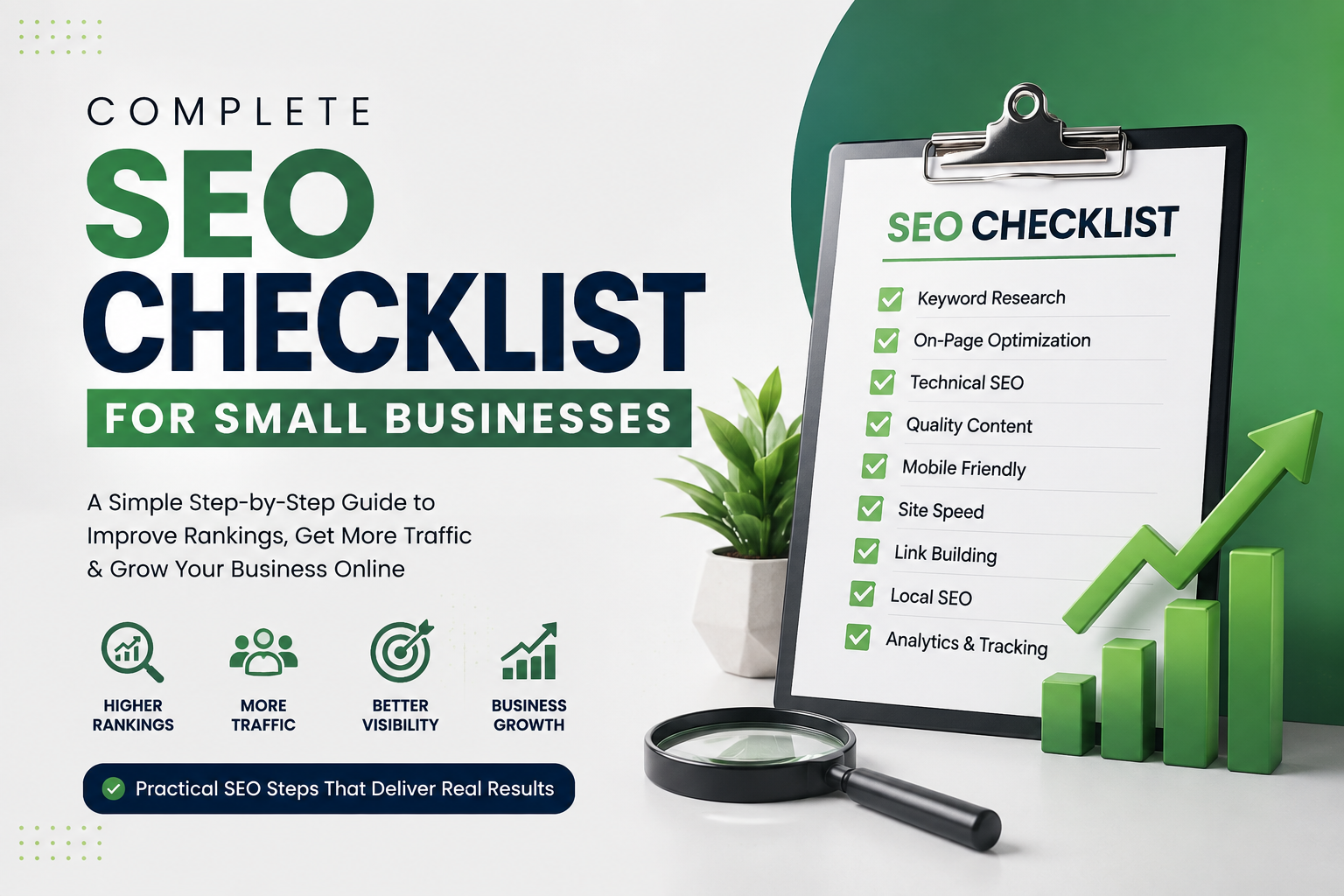
For small businesses, setting up a website is just the beginning; if potential customers can’t find your business on Google, your website will not bring about the level of traffic and leads that you expect. Search Engine Optimization (SEO) enables your business to appear in relevant searches, draws in qualified visitors, and helps to establish long-term online visibility.
The good news is that it’s possible to begin improving your SEO without having a large marketing budget. As long as you stick to a structured checklist and keep focusing on the basic elements, small businesses can establish a stronger position in search results.
1. Set up Google Search Console
One of the most important free tools available to website owners is the Google Search Console.
Make sure you:
Verify your website.
Submit your XML sitemap.
Check indexing status.
Keep an eye on the search queries and impressions.
Find the pages that have indexing problems.
Monitor Core Web Vitals.
Make sure that the mobile usability is checked.
Look at the pages that are receiving search traffic.
By regularly checking Search Console you can pick up on SEO problems before they turn into more serious issues.
2. Perform Keyword Research
Before you produce any content, make sure you know what your potential customers are searching for.
Focus on:
Primary keywords
Long-tail keywords
Local keywords
Service-related searches
Question-based searches
Commercial keywords
For example, a digital marketing business in Kerala might target keywords such as:
Digital marketing agency in Kochi
SEO services in Kochi
Social media marketing agency in Kochi
Website development company in Kochi
Do not aim at a large number of unrelated keywords on one page; each important page should have a definite search intention and a main keyword.
3. Make sure your page titles and meta descriptions are optimised.
Each important page should have its own clear and specific title.
A good title should:
Clearly describe the page.
Make sure the main keyword is included in a natural way.
Encourage users to click.
Avoid unnecessary keyword repetition.
A meta description should tell visitors what they can expect when they visit the page and provide them with a reason to do so.
4. Optimize Your Headings
Make sure that your website has a logical heading structure.
The main page should usually include one clear H1 heading, together with relevant H2 and H3 sections.
For example:
H1: Digital Marketing Services in Kochi
H2: Our Digital Marketing Services
Heading 2: The Reason for Selecting Our Agency?
H3: SEO Services
H3: Social Media Marketing
H3: Google Ads Management
Headings that are clear make it easier for both users and search engines to understand your content.
5. Make Your Website Content Better
You should create content that addresses the questions your customers really have.
Rather than producing content that is solely designed for search engines, create information that is useful and helps visitors make their decisions.
Include:
Detailed service descriptions
Benefits
Pricing information where appropriate
FAQs
Case studies
Customer experiences
Examples
Helpful guides
Good quality content also provides opportunities for other websites to create links to your pages.
6. Optimize Images
Your website can run slowly if it contains large, unoptimized images.
Make sure you:
Compress images before uploading.
It is appropriate to use formats such as WebP nowadays.
Give images descriptive filenames.
Add meaningful ALT text.
Do not use images that are bigger than needed.
For example, instead of:
IMG_4587.jpg
use:
social-media-marketing-kochi.jpg
When it gives a correct description of the image.
7. Improve Website Speed
A quicker website leads to a better user experience and is more favourable for technical SEO.
Check:
Page loading speed
Core Web Vitals
Image sizes
JavaScript
CSS
Third-party scripts
Hosting performance
Mobile performance
Do not include any plugins, animations, or scripts that are not essential since they might slow your website down.
8. Make Your Website Mobile-Friendly
A great deal of the traffic on websites is来自于 mobile devices.
Test your website on different screen sizes and make sure:
The text is easy to read.
Buttons are simple to press.
Navigation works properly.
Images fit the screen.
Forms work correctly.
The essential information can be seen without having to scroll unnecessarily.
A website which functions well on mobile provides a better experience for both visitors and search users.
9. Improve Internal Linking
Internal links are used to connect various pages within your website.
For example:
Blog Article → SEO Service → Contact Page
When you are publishing a new article, look for chances to include links to relevant services, products, and related articles.
Good internal linking not only helps visitors to find out about more of your content but also assists search engines in understanding the relationships between your pages.
10. Build Quality Backlinks
Backlinks are links which go from other websites to yours.
Rather than attempting to obtain hundreds of low-quality links, it’s better to get links from websites that are relevant and trustworthy.
You can build backlinks through:
Guest articles
Industry publications
Local business directories
Business partnerships
Digital PR
Original research
Useful resources
Local news websites
Industry associations
For a locally based business, relevant local backlinks can be of great value.
11. Improve Your Google Business Profile
Local SEO should be included in your strategy if you are serving customers in a particular location.
Keep your Google Business Profile updated with:
Correct business name
Address
Phone number
Website
Business category
Opening hours
Services
Photos
Posts
Customer reviews
Encourage real customers to write reviews and give them a professional response.
12. Maintain NAP Consistency
NAP stands for:
Name + Address + Phone Number
Check that the business details you provide are the same on your website, Google Business Profile, directories, social media platforms, and all other online listings.
Inconsistent information can cause confusion among customers and search engines.
13. Make content for local SEO
When you are operating in a particular city, make sure to produce some content that is relevant to the location.
For example:
Digital Marketing Services in Kochi
SEO Guide for Kochi Businesses
Best Marketing Strategies for Kerala Startups
How Local Businesses Can Generate Leads Online
Do not produce many city pages that are almost exactly the same merely in order to rank for different locations; instead, each location page should contain truly useful and unique information.
14. Use Social Media to Help SEO
Social media doesn’t take the place of SEO, but it can help to increase the reach and visibility of your content.
Share:
Blog posts
Case studies
Videos
Infographics
Industry insights
Customer success stories
Educational content
It is also possible for businesses to develop a consistent content strategy, boost their brand visibility, and draw more users to their website by working with a social media marketing agency in Kochi.
15. Add Schema Markup
Structured data enables search engines to understand the specific information on your website.
Depending on your business, consider relevant schema such as:
Organization
LocalBusiness
Service
Product
Article
FAQ
Breadcrumb
Use only schemas that correctly represent the content on the page.
16. Set up a URL structure that is friendly for SEO
Make sure that URLs are short, descriptive, and easy to understand.
Instead of:
example.com/page?id=2847
use something like:
example.com/seo-services-kochi
Do not use URLs that are too long and avoid having an excessive number of numbers or parameters.
17. Fix broken links and technical problems.
Regularly check your website for:
404 errors
Broken internal links
Broken external links
Redirect chains
Incorrect redirects
Duplicate pages
Missing canonical tags
Indexing problems
Technical problems may stop search engines from being able to properly crawl and understand your website.
18. Publish Content Consistently
SEO should not be considered a one-off task.
Put together a realistic content schedule and make it a habit to publish useful content on topics that your customers care about.
A small business could start with:
2–4 quality blog articles per month
Weekly social media content
Monthly SEO performance reviews
Regular website updates
It is better to be consistent than to publish a large quantity of poor quality content.
19. Keep an eye on your SEO performance
Track important metrics such as:
Organic traffic
Keyword rankings
Search impressions
Click-through rate
Backlinks
Indexed pages
Leads
Conversions
Local search visibility
It’s not enough to concentrate solely on rankings. The real aim is to secure relevant traffic, leads, and customers.
20. Keep Improving
SEO is constantly changing. Search algorithms, user behaviour, competitors, and search technology all change over time.
Keep a regular check of your website and make sure that old content is updated, weak performing pages are improved, new relevant backlinks are acquired, and your content is expanded in response to what your audience is searching for.
Small Business SEO Checklist
Set up Google Search Console
Submit your sitemap
Perform keyword research
Optimize page titles
Write unique meta descriptions
Improve H1/H2/H3 structure
Optimize website content
Compress images
Improve page speed
Make the website mobile-friendly
Build internal links
Earn quality backlinks
Optimize Google Business Profile
Keep NAP information consistent
Create local content
Promote content through social media
Add relevant schema markup
Optimize URLs
Fix broken links
Publish useful content consistently
Monitor SEO performance
Final Thoughts
Small businesses need not find SEO complicated since the main thing is to establish a solid base and then keep improving it. You should begin with technical SEO and on-page optimisation before concentrating on local SEO, content creation, internal linking, and obtaining high-quality backlinks.
If you use these strategies together, your website will be able to draw in more relevant visitors, establish greater online authority, and create more business opportunities.
For businesses that are operating in a local market, combining search engine optimisation with social media, content marketing and other digital strategies can result in an even more effective online presence. By working with an appropriate social media marketing agency in Kochi it is possible to turn that level of visibility into continuous audience engagement and a number of potential leads.